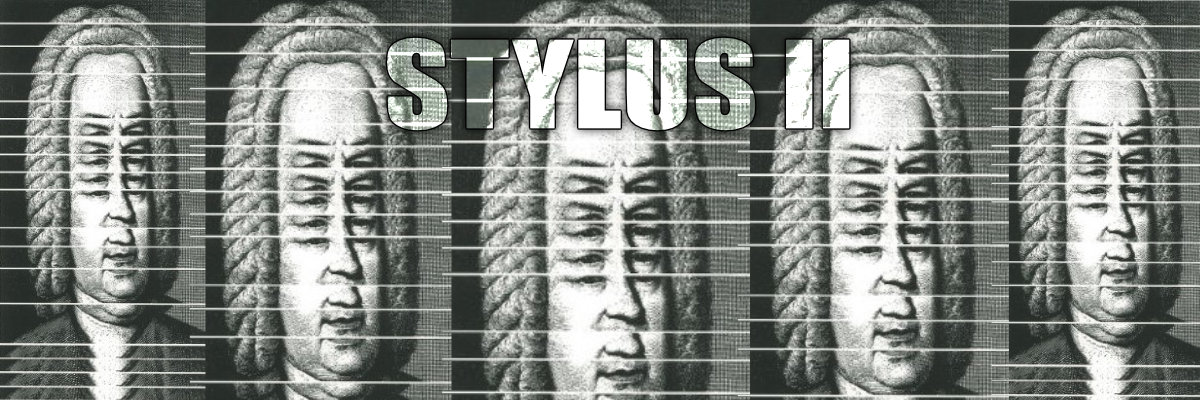
As with its "Stylus" predecessors, in this one too, I was intrigued by the possibility of changing the semantic continuity of Bach’s music (Contrapunctus VII) by means of strategically-placed asymmetrical repetitions. In aural terms, the effect is similar to that created by the skipping of the stylus of a record-player. By using repetitions within repetitions, phasing repetitions (where the left or right bracket advances or retreats by a sixteenth-note after each iteration), and by occasionally choosing similar beginning and end points which result in continuous melodic and contrapuntal flow within a loop, I sought to create a composition which parallels the original but nevertheless possesses a character and style of its own. Additionally, in STYLUS II, I have used extensive articulation and (particular to this version) a constantly antiphonal passing of motifs across the acoustic space. The ordering on stage of the saxophones is (from left to right) soprano, alto, tenor, baritone, tenor, soprano, alto. An additional feature in this movement is the sudden and unexpected drops in amplitude and pacing, which makes the music sound like the timbral transformation of sounds when our ears are submerged in water (a vivid experience of my childhood when I submerged my head in the water of the Aegean Sea during summer vacations.
Christos Hatzis
For more information on the compositional technique associated with this composition, please visit The Art of the Palimpsest: Compositional Approaches to the Music of Johann Sebastian Bach
May 08. Stylus II. World Premiere. Sax Nouveau, under the direction of George Lygeridis The Olympic Sax Fest, Thessaloniki 2025. Thessaloniki Concert Hall, Thessaloniki, Greece.